Hasim 3.1.0 · Green Hydrogen Engineering Suite

Design green hydrogen plants from the cell to the plant fence – in minutes.

Hasim turns a design basis into a complete engineering package: process flow and single-line diagrams, stream tables, equipment datasheets, energy and mass balances, an 8760-hour simulation, economics, safety distances and a printable design report.

Windows 10/11 · works offline · one price, paid once · free 14-day trial in your browser
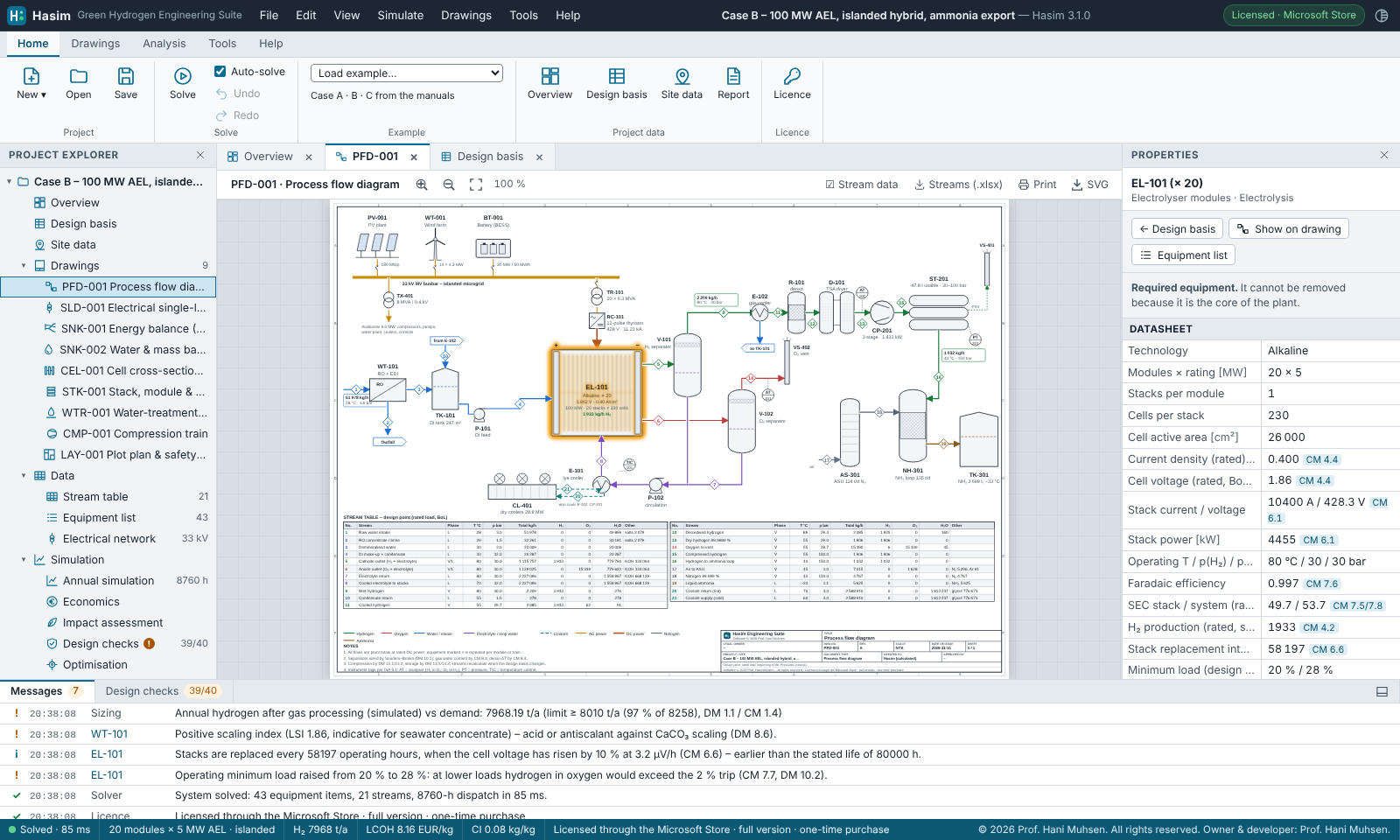
Hasim engineering workstation with a process flow diagram
158engineering equations
9engineering drawings
8760 hannual dispatch simulation
318validation checks
234comparisons with measured plants and tools
See it in action

Hasim in two minutes

From the design basis to drawings, a full-year simulation, economics, the optimiser, site data, risk curves and incentives, design checks and the design report – the Store edition as you will use it.

▶ Tutorial series on YouTube – @HasimSoftware
Step-by-step videos: one plant designed end to end, from the cell model to the design report.

What Hasim does

A complete engineering workstation for green hydrogen

Edit the design basis in the property grid and the whole system is re-solved instantly – equipment, streams, drawings, annual performance, costs and design checks stay consistent.

New in Hasim 3.0 and 3.0.1

Optimise the plant, import site data, quantify risk and incentives – then teach, firm up the power and hand over to the simulators

Version 3.0 adds the decision tools of a feasibility study around the same engineering model – every candidate design, weather year and policy case is solved with the complete plant – and 3.0.1 adds the course for teaching, firm power from hydrogen, the export for ETAP and process simulators, the regional policy packs and a safety-engineering package.

  • Plant-sizing optimiser by differential evolution with the design checks as constraints – lowest LCOH, highest margin or lowest P90
  • Measured weather from PVGIS, NASA POWER, EPW, TMY3, NSRDB or CSV with quality control, hourly day-ahead prices and grid carbon, price-following grid use and the RFNBO low-price rule
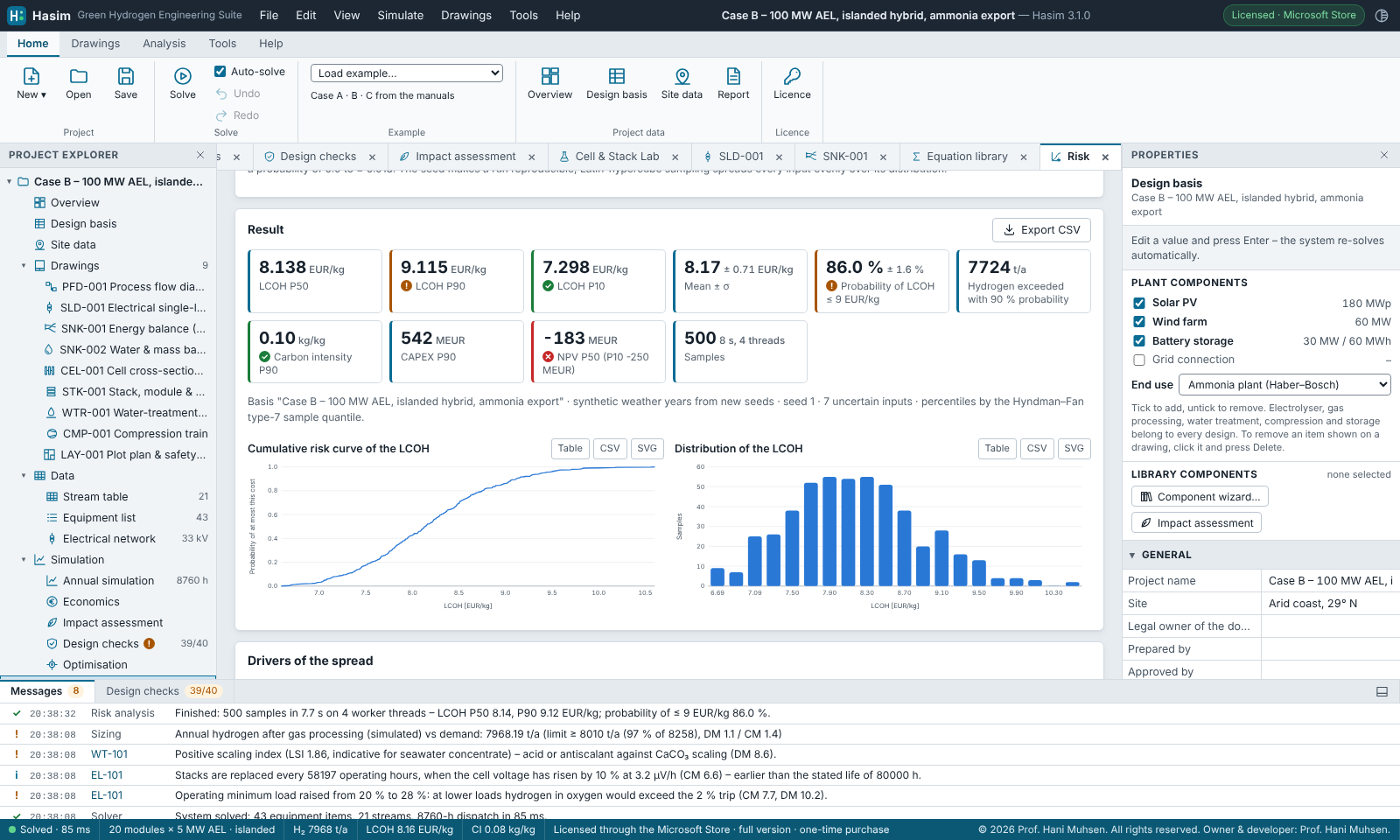
  • Monte Carlo risk curves: Latin-hypercube samples on all cores, P10/P50/P90, the probability of a cost target and the drivers of the spread
  • Policy packs – EU Hydrogen Bank, US § 45V, India SIGHT, contracts for difference and carbon pricing, and regional packs for Jordan, Egypt, Morocco, Oman and Saudi Arabia with tax holidays, relief and royalties – in the levelised cost after incentives, NPV, IRR and payback
  • Firm power from hydrogen: a fuel cell, hydrogen engine or turbine that serves the auxiliaries and a site load from the stored hydrogen – the microgrid case of islanded plants
  • Export for simulators: the single-line data with IEC 60909 fault levels as a workbook for ETAP and other power-system tools, and the stream table with compositions, components and unit operations for process simulators
Monte Carlo risk curves of a plant
New in 3.0.2: process engineering, heat and water, certification

The ammonia loop, the utilities and the certification tests – from the solved plant

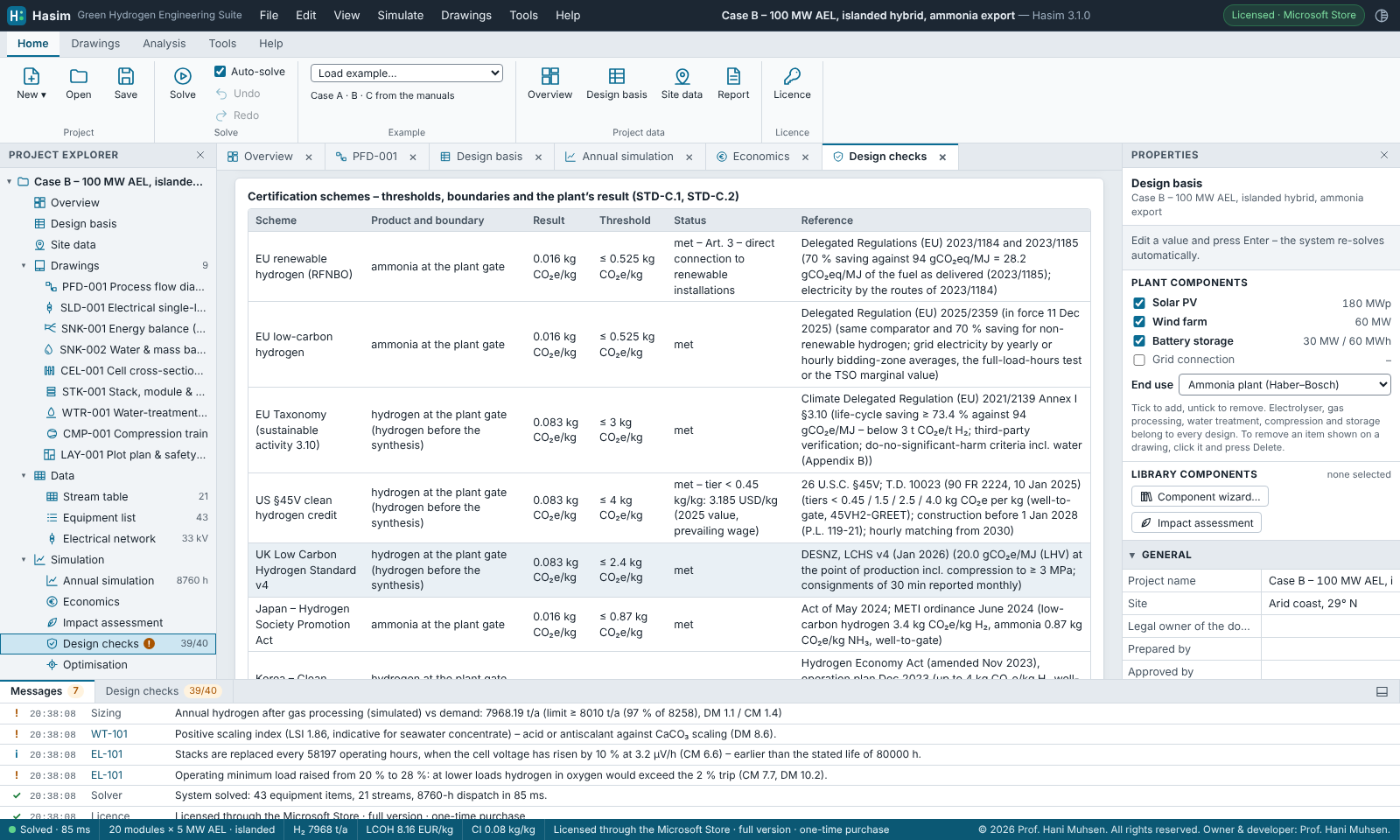
Version 3.0.2 extends the screening of every solved design into the process plant and the market it sells to: the ammonia synthesis loop with its flexibility, pumps, compressors and dryers; the heat the plant can recover or sell and the water it withdraws; and the certification tests – EU renewable hydrogen, the carbon intensity as delivered, nine schemes and the CBAM. Everything is built from published regulations and standards, each value with its reference, and nothing changes the results of earlier projects unless you ask for it.

  • Ammonia synthesis loop: real-gas equilibrium, per-pass conversion, recycle, purge and refrigeration; conventional, flexible and highly flexible loops checked against the hourly hydrogen offtake – or applied to it, with the storage following
  • Pump NPSH to ANSI/HI 9.6.1, compressor capacity control, dryer regeneration heat and the oxygen compounds in the loop feed
  • Heat sources and users with pinch targets; heat sales to a district-heating or process customer, directly or with a heat pump; dry, wet or hybrid cooling with the water withdrawn, consumed and discharged per kg of hydrogen
  • EU renewable hydrogen: additionality, temporal and geographic correlation and the bidding-zone routes of Delegated Regulation 2023/1184, the GHG of 2023/1185, and the carbon intensity of hydrogen or ammonia as delivered by ship, pipeline, cracking, liquid hydrogen or LOHC
  • Scorecard of nine certification schemes – EU RFNBO and low-carbon hydrogen, EU Taxonomy, US § 45V, UK LCHS, Japan, Korea, India, GH2 – CBAM certificates and cost, and an evidence pack with the hourly ledger for the auditor
Certification schemes scorecard in the design checks
New in 3.0.1: safety engineering

Emergency shutdown, SIL, relief, arc flash and fire and gas – from the solved design

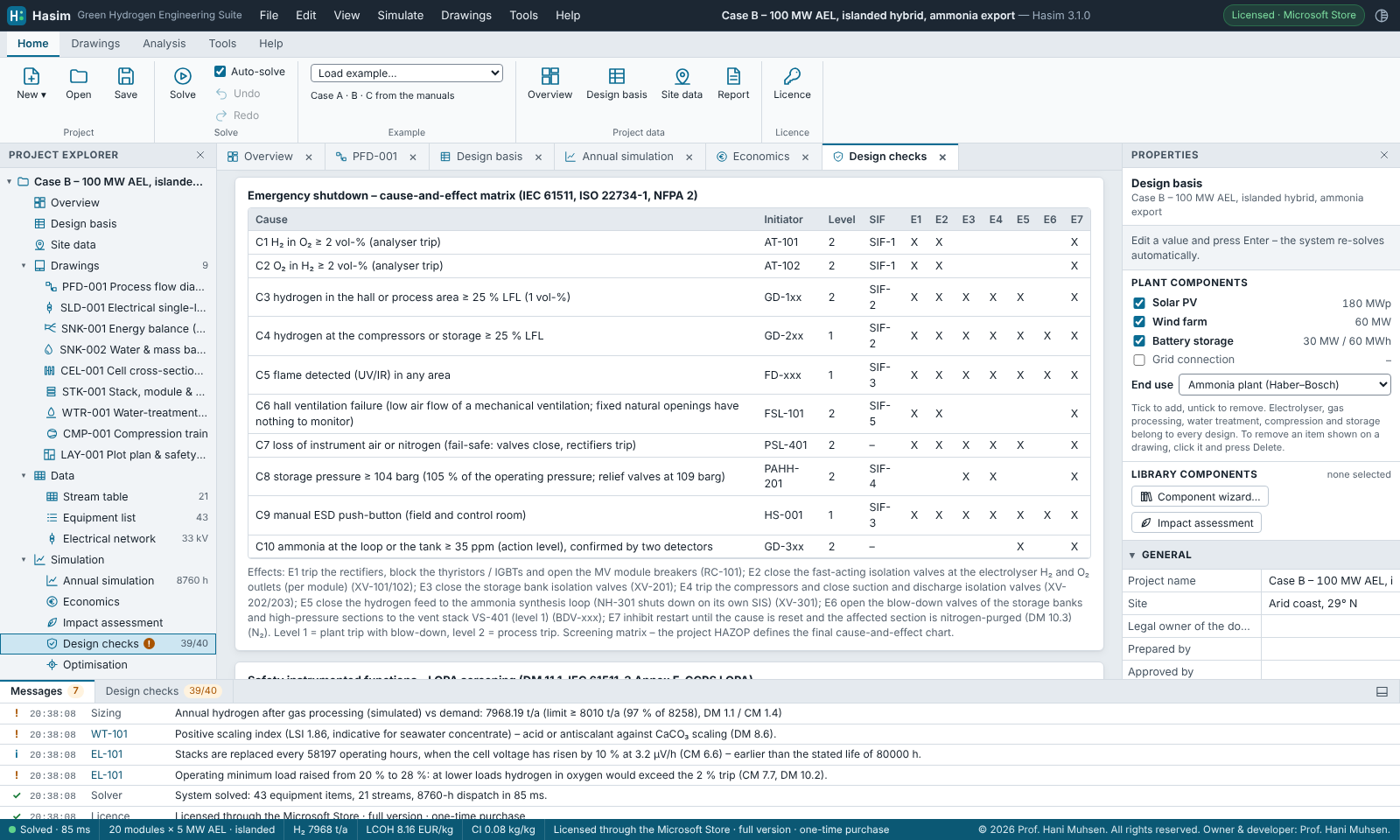
Every solved design now carries a concept-level safety package built from published standards: the shutdown logic and safety integrity levels, depressuring and relief, the arc-flash data of the DC and AC buses, fire and gas detection, ventilation and the materials of every stream – each value with its reference, as screening that does not replace the safety studies of the project.

  • Emergency-shutdown cause-and-effect matrix, tagged ESD, blow-down and relief valves, and the required SIL of each safety function by LOPA (IEC 61511)
  • Depressuring to API 521 with the vent-stack radiation at grade; relief valves sized to API 520 with the API 526 orifice
  • Arc flash on the electrolyser DC bus (NFPA 70E) and at the rectifier transformer and MV bus (IEEE 1584-2018) with PPE category and boundary
  • Fire and gas detector schedule marked on the plot plan, natural roof ventilation of the enclosures and Ex protection types on the datasheets
  • Materials and piping class per stream: API 941 hot-hydrogen screening, ammonia service rules, ASME B31.12 and B16.5
Emergency-shutdown cause-and-effect matrix in the design checks
Process engineering

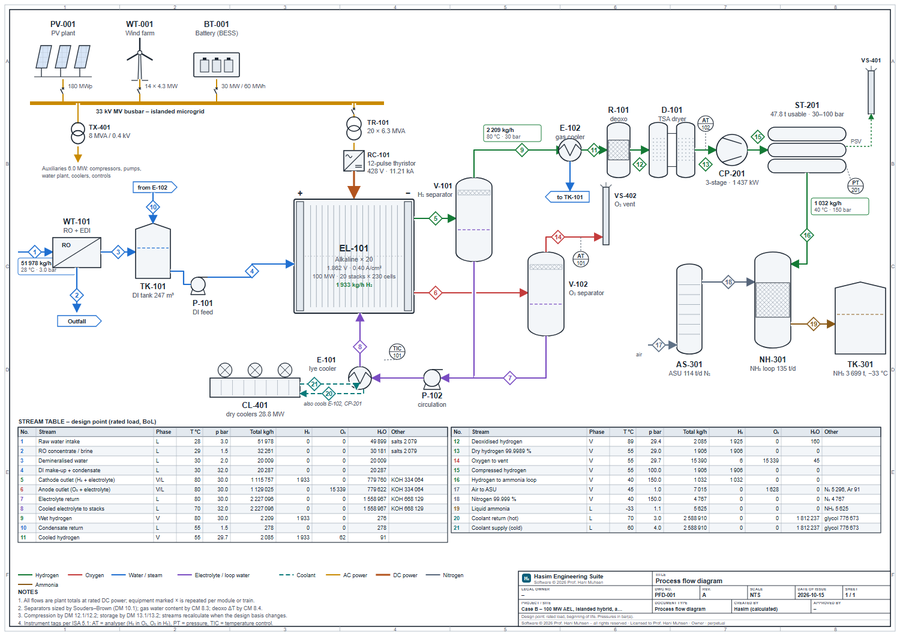
Process flow diagram with a live stream table

The PFD follows ISO 10628 conventions with numbered streams, equipment tags and instrument bubbles. Every stream carries temperature, pressure, mass and volume flow and composition.

  • Electrolyser stacks, separators, gas processing, deoxo and TSA dryers
  • Water treatment, cooling loops, compression, storage and end use
  • Click any item for its datasheet; hover a stream for its data
  • Export drawings as SVG, tables as CSV and the stream table with compositions as a workbook for process simulators
Process flow diagram
Electrical engineering

Single-line diagram and power-electronics sizing

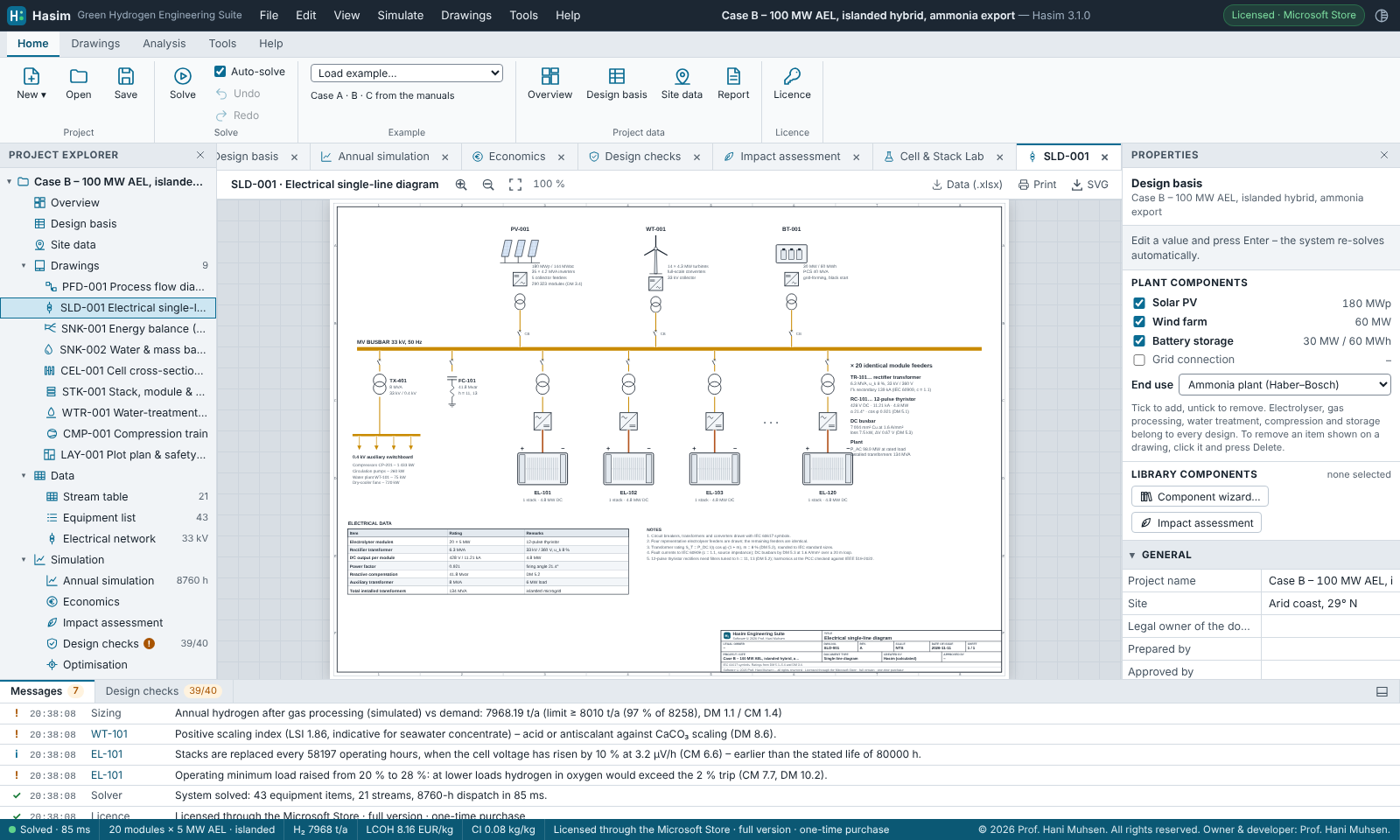
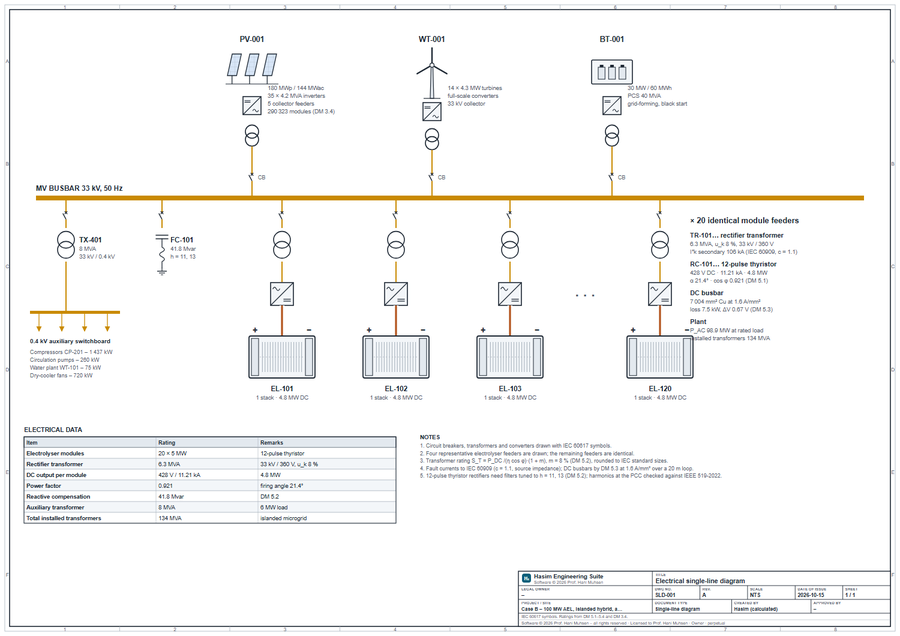
Transformers, rectifiers, harmonic filters, busbars and the MV connection are sized with the equations of the design manual and drawn with IEC 60617 symbols.

  • Thyristor 12-pulse or IGBT active front-end rectifiers
  • Short-circuit currents (IEC 60909), harmonics at the PCC (IEEE 519-2022), power factor
  • PV inverters, wind turbines, battery and grid feeders
  • Auxiliary transformer and load list
  • Element tables with the fault levels of every bus, exported as a workbook for ETAP and other power-system tools
Electrical single-line diagram
Balances

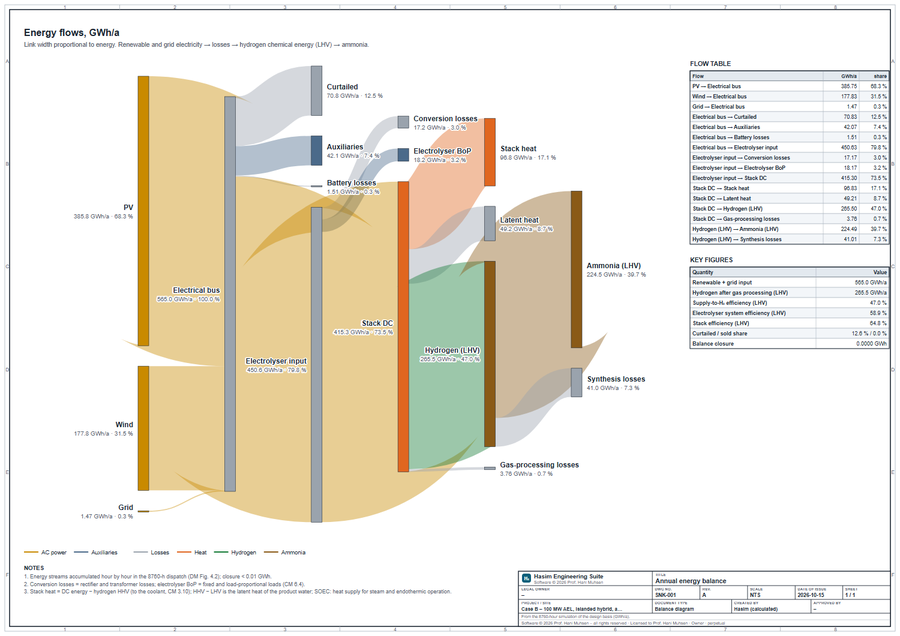
Energy and mass balances as Sankey diagrams

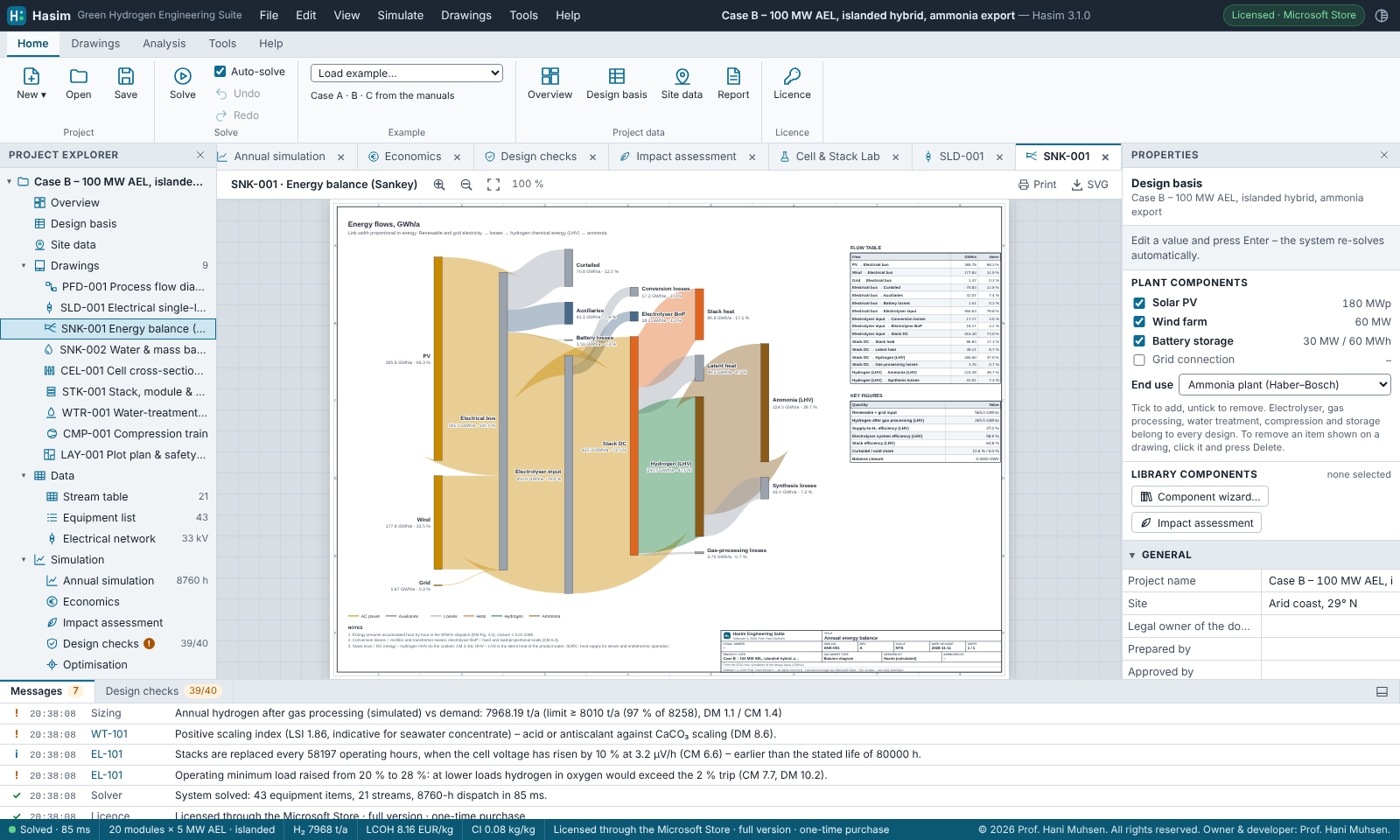
The annual energy flow from PV, wind and grid through conversion losses to the chemical energy of hydrogen – and the water balance from raw water to hydrogen, oxygen and brine – close to machine precision.

  • Curtailment, battery, auxiliary and conversion losses
  • Raw water, demineralised water, brine and blowdown
  • Ammonia synthesis for Power-to-X cases
  • Balance closure reported as a design check
Energy Sankey diagram
Simulation

8760-hour dispatch with a live power-flow view

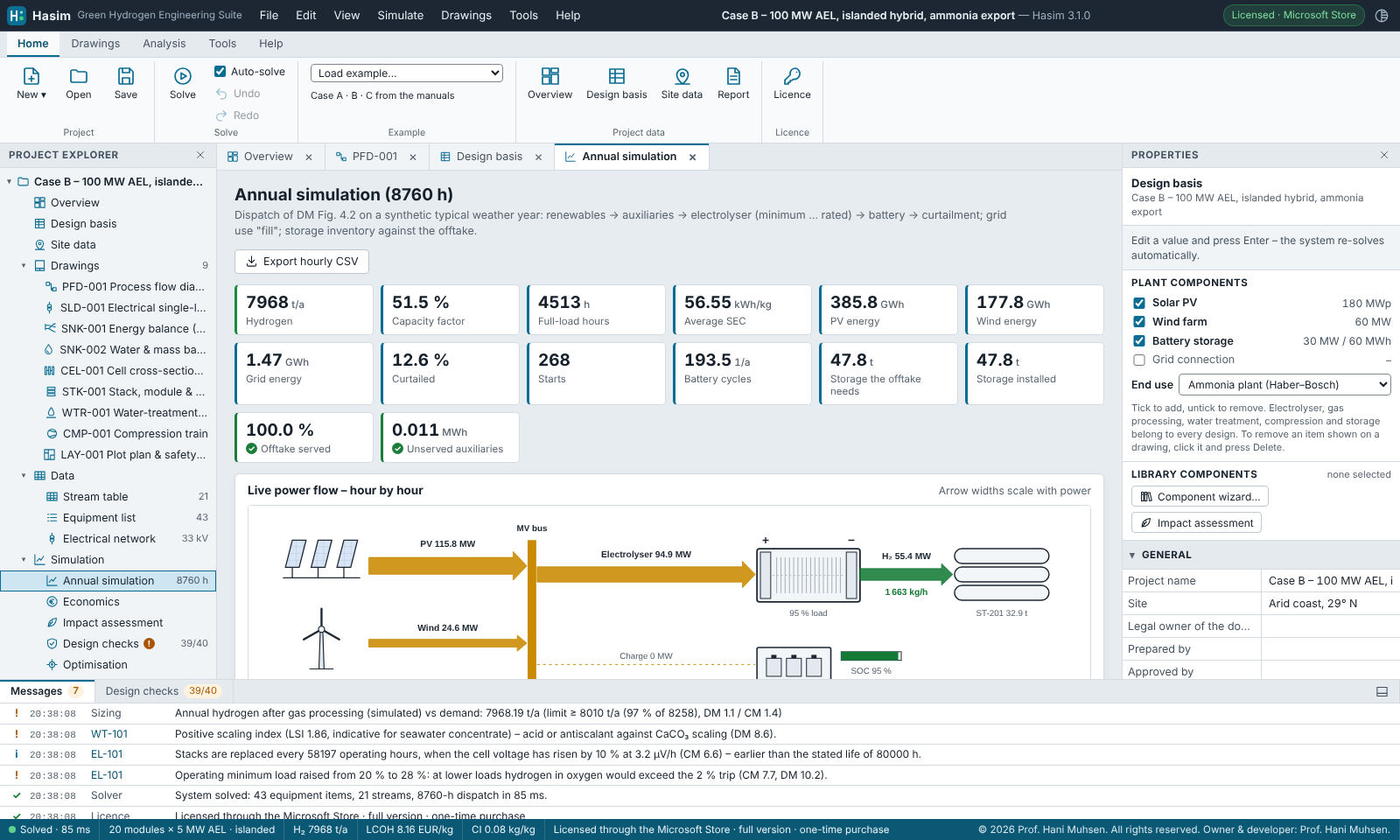
A synthetic typical year of weather drives the dispatch of renewables, battery, grid and electrolyser against the storage and offtake – watch any hour of the year in the power-flow player.

  • Capacity factor, full-load hours, starts and curtailment
  • Battery cycles, storage inventory and unserved energy
  • Load-duration curve and hour-by-day heat map
  • Hourly results exportable to CSV
Annual simulation with power flow
Economics

LCOH, CAPEX and sensitivity in one click

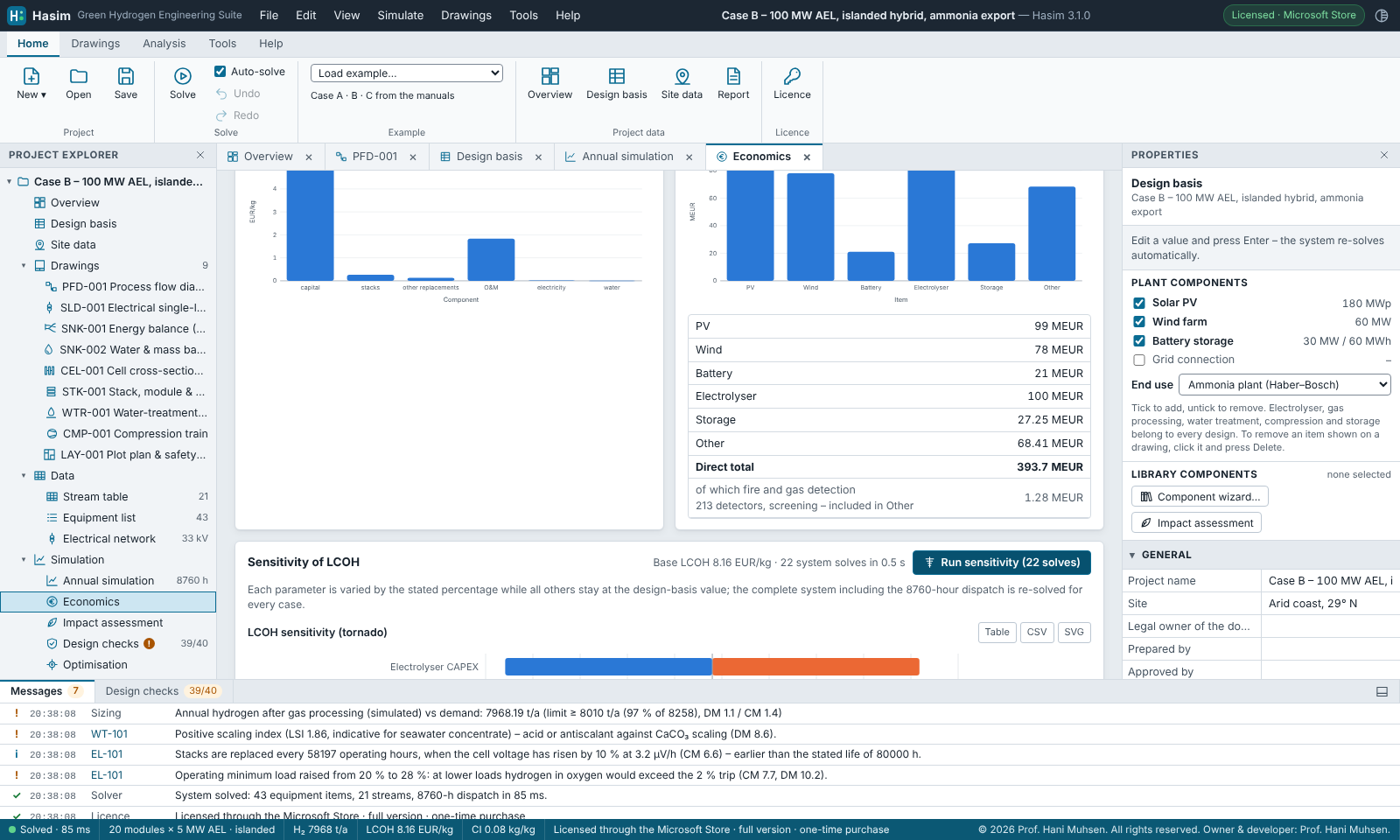
Levelised cost of hydrogen from the full-year simulation, CAPEX build-up, and a one-at-a-time sensitivity analysis that re-solves the complete system for every case.

  • LCOH breakdown: capital, stacks, O&M, electricity, water
  • Tornado chart of the key drivers
  • Carbon intensity with hourly and monthly matching (RFNBO)
  • Design report with all assumptions and references
Economics and sensitivity analysis
Engineering tools

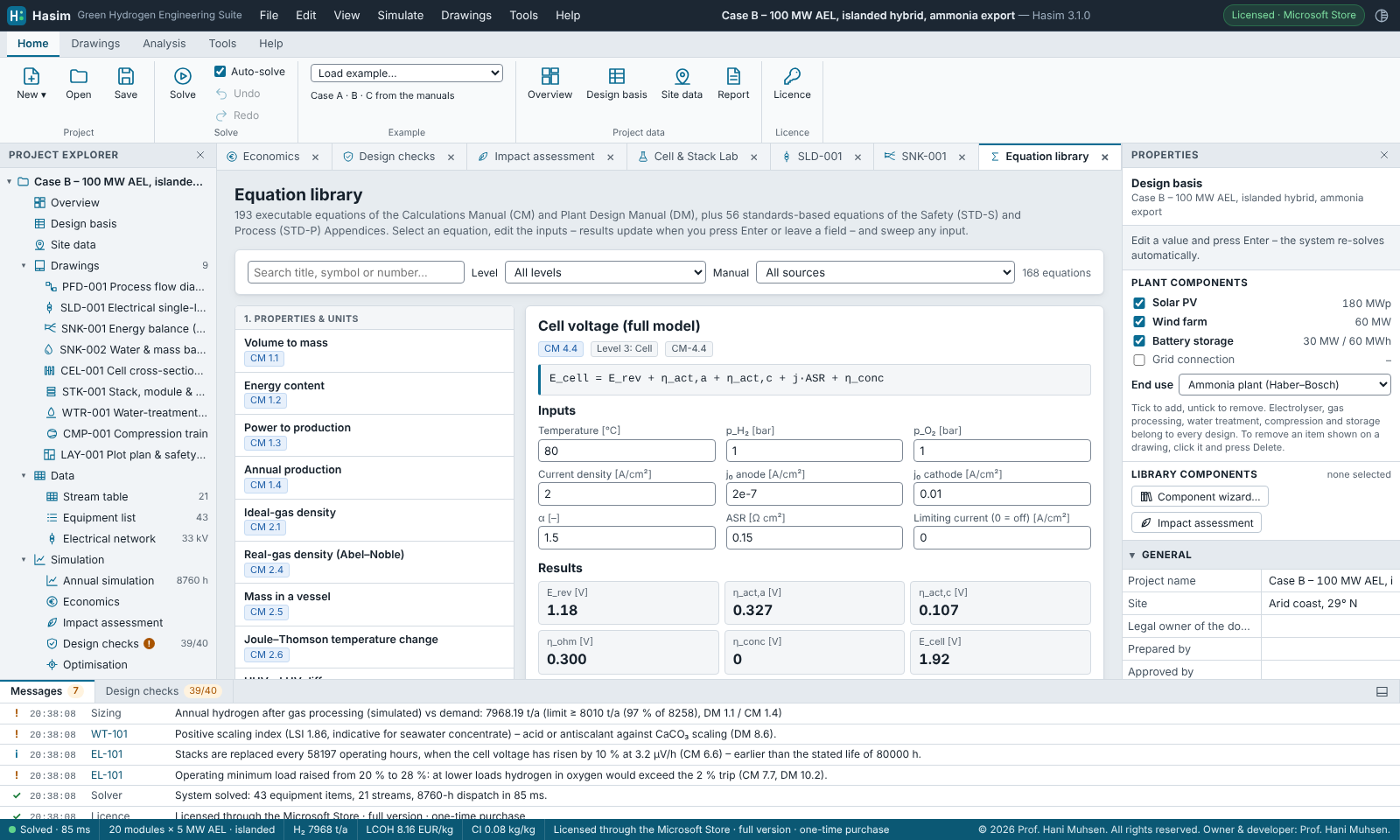
158 equations, a Cell & Stack Lab and a script console

Every numbered equation of the underlying calculation and plant-design manuals and of the safety, process and certification appendices is available as a live calculator with parametric sweeps – the manual equations validated against 318 worked-example values, the standards-based equations against the worked examples of the standards and the published problems.

  • Polarisation curves, losses, part-load and gas purity
  • Seventeen ready-made engineering experiments
  • Block-based model builder from supply to end use
  • JavaScript API for automated studies
Equation library
Teaching

A course inside the workstation

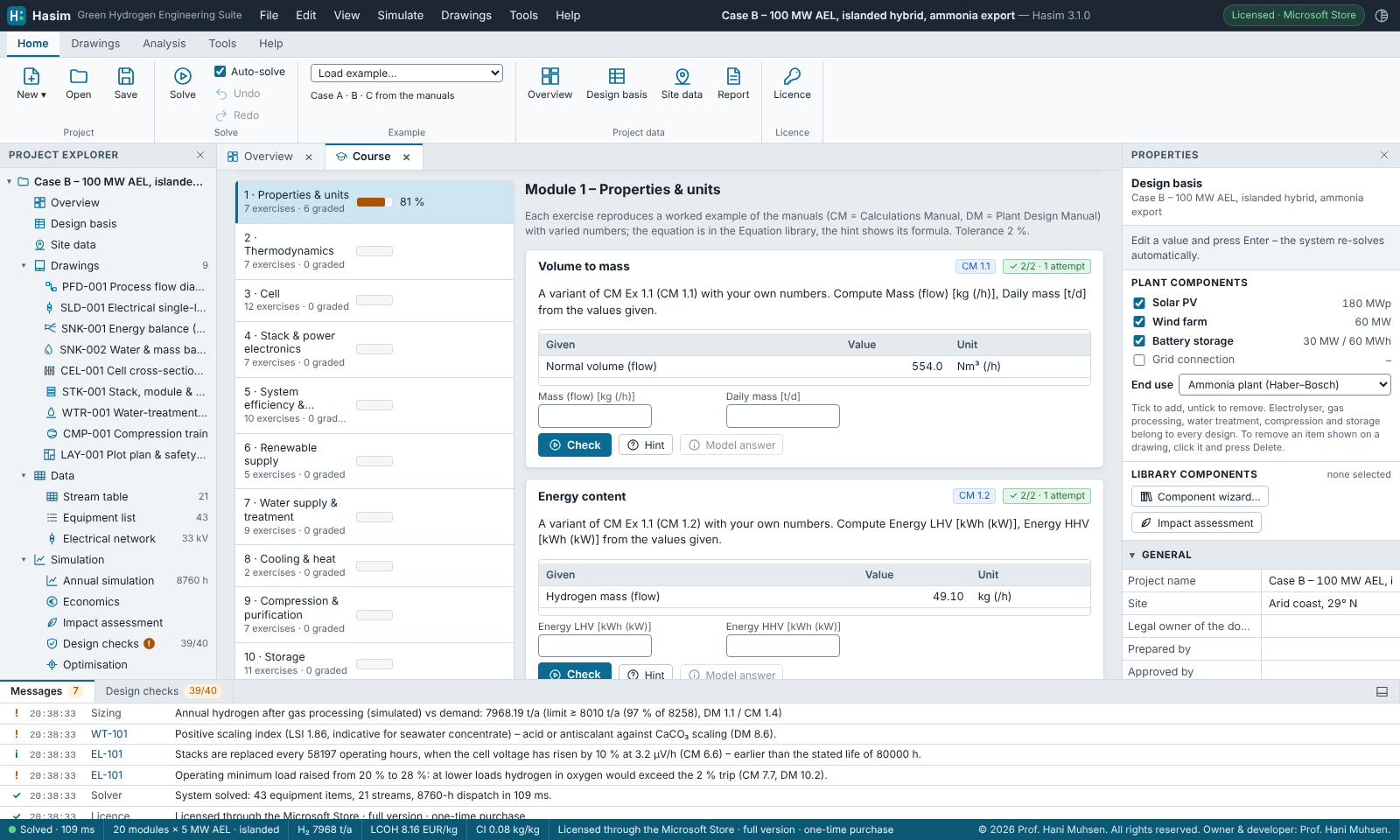
Hasim teaches as well as it designs: a course of graded exercises for students of hydrogen engineering – and the instructor's classroom table – with no server, no account and nothing to install besides Hasim.

  • 124 graded exercises in 17 modules: the worked examples of the two engineering manuals and plant-design studies on the example cases
  • Every student gets their own numbers from their student identifier; the engine computes the model answer, so there is no answer key
  • Results file with a verification code, printable certificate, and the Classroom table that verifies every file and exports to the grade book
  • Site licences for universities and training centres cover every seat of a course
The Course document with graded exercises
Sustainability

Component library and impact assessment

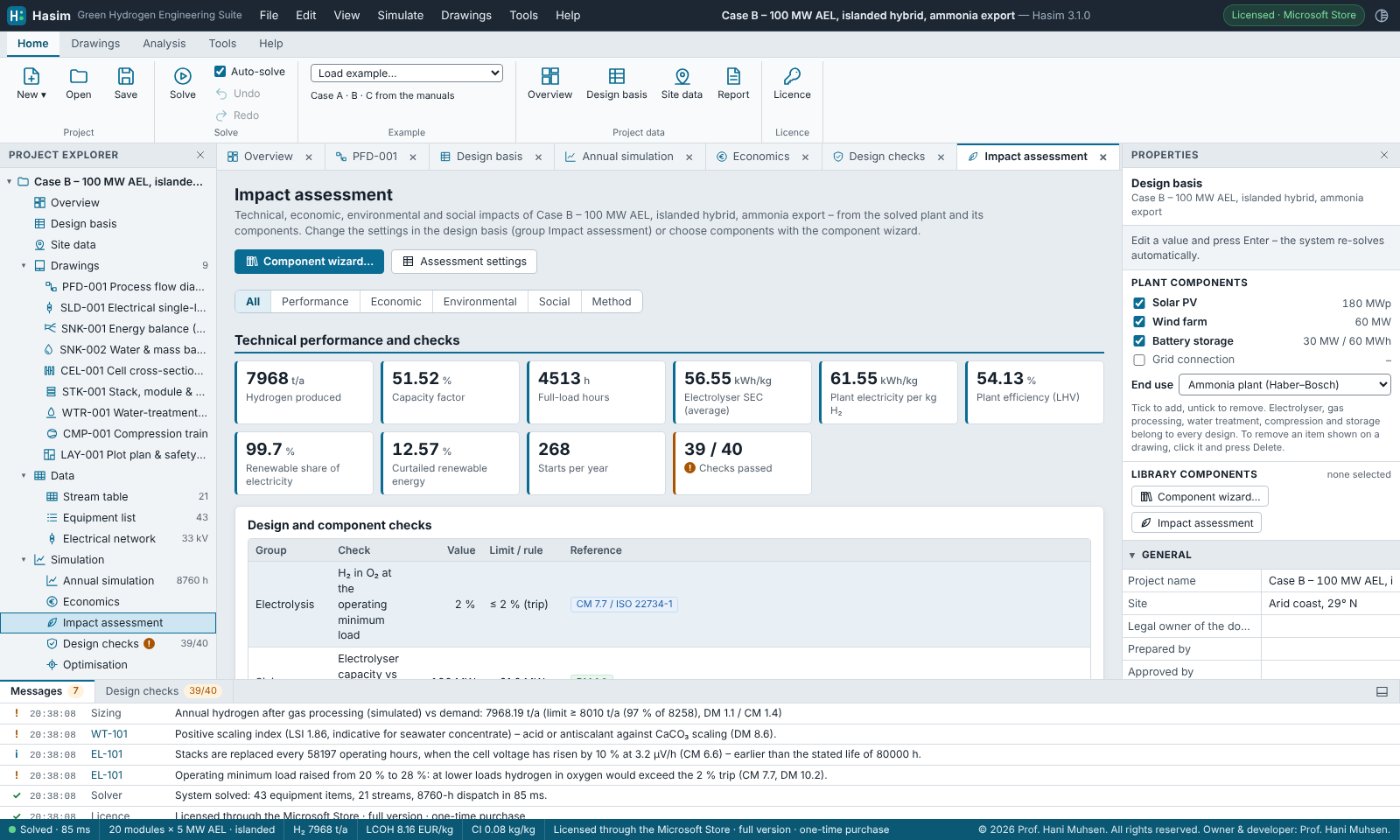
Build plants and value chains from a library of generic equipment – or from your own supplier data – and see the technical, economic, environmental and social impacts while you design.

  • 35 components: PV, wind turbines for all IEC classes and offshore, batteries, water plants, stacks, power electronics, compressors, storage, delivery and ammonia
  • Component wizard with the live effect on LCOH, carbon intensity, jobs and design checks
  • Life-cycle carbon intensity, water stress, land use and local content
  • Construction and permanent jobs, hazard distances and Seveso III tier
Impact assessment of a plant
Drawing set

Nine engineering drawings, regenerated on every change

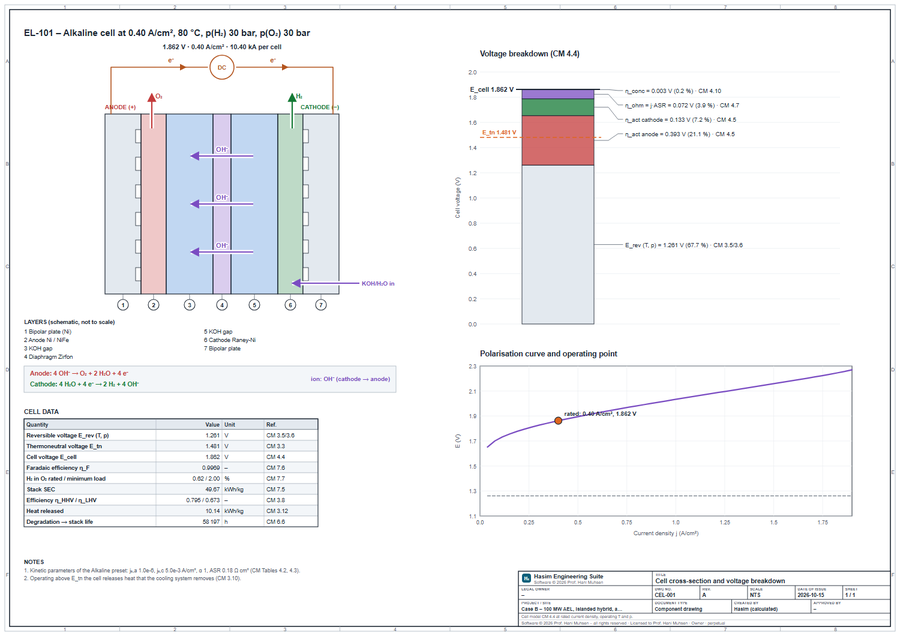
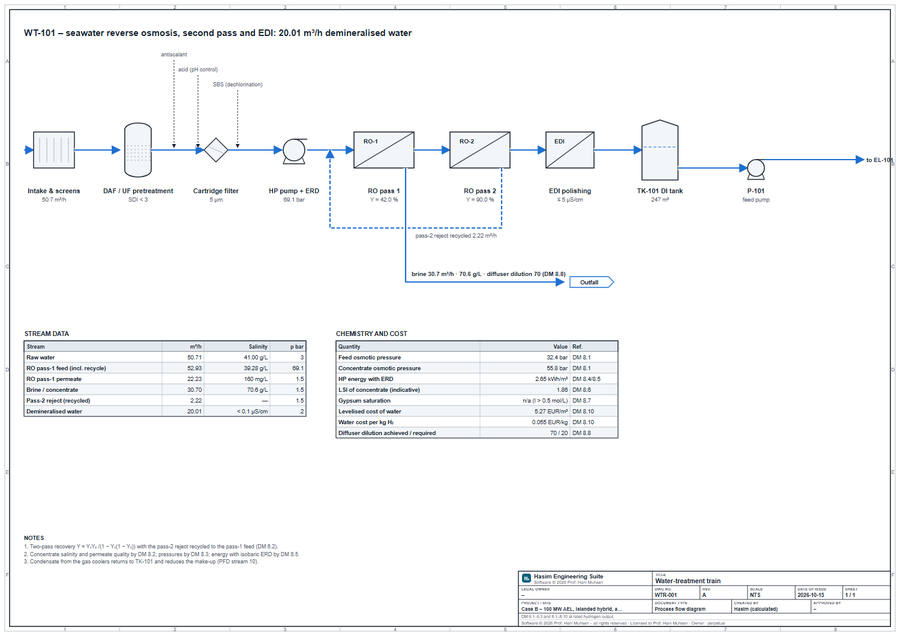
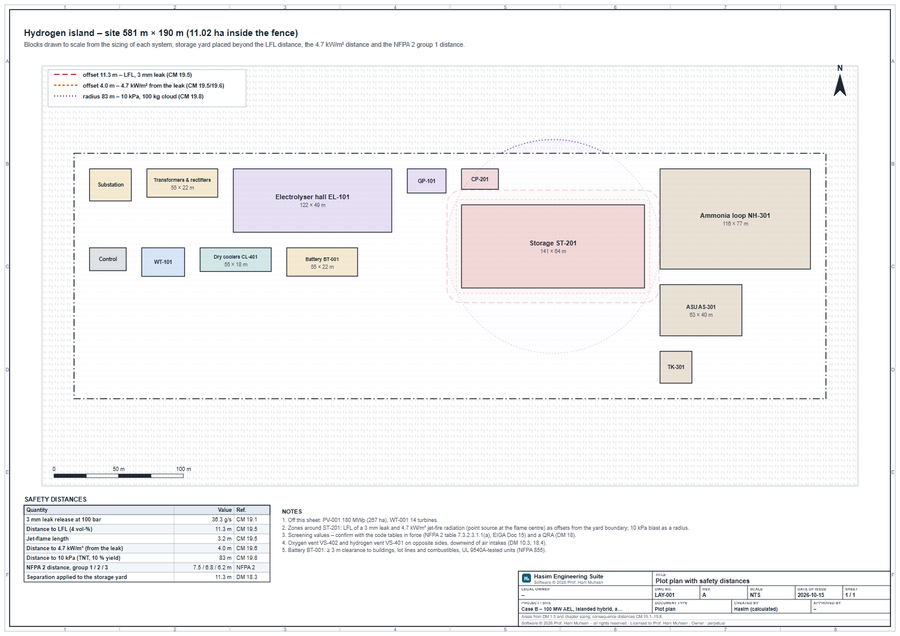
Each drawing is produced on a sheet with frame, zones and title block – ready for design reviews and reports.

Technical scope

What you can model

ElectrolysisPEM, alkaline (AEL), AEM and solid-oxide (SOEC); cell, stack, module and plant level; degradation, stack life and gas purity (ISO 22734-1).
Power supplyGrid with PPA, islanded PV–wind–battery hybrids, grid top-up modes, auxiliary backup.
WaterMunicipal water or seawater RO with EDI polishing, scaling indices, brine dilution and water cost.
Heat and gas processingElectrolyte cooling, dry coolers, gas cooling, deoxo and TSA drying.
Compression and storageMultistage compression within the API 618 temperature limit, real-gas storage sizing, ASME VIII vessel walls and PED category.
Delivery and end usePipelines, tube trailers, 70 MPa refuelling stations and ammonia synthesis.
Economics and carbonCAPEX, OPEX, stack replacement from degradation, LCOH; RFNBO, EU Taxonomy and US 45V carbon screening.
Safety and codesLeak, jet-fire and overpressure distances, NFPA 2 separation, hazardous areas (IEC 60079-10-1), Seveso III and OSHA PSM screening, ASME B31.12 pipelines.
Pricing

One price, paid once

Hasim is sold in the Microsoft Store as a one-time purchase – a lifetime licence for one user with all updates of the Store edition. No subscription, no licence key, no sign-in.

Microsoft Store

Hasim for Windows

Lifetime licence for one user
US$ 130.99
one-time purchase · no subscription
  • Every function: drawings, stream and equipment tables, 8760-hour simulation, economics, design checks and report
  • Equation library, Cell & Stack Lab, experiments, model builder and script console
  • Component library, component wizard and impact assessment
  • Commercial and non-commercial use; unwatermarked outputs
  • All updates of the Microsoft Store edition
  • Works offline – your projects stay on your computer
Get it from Microsoft

The Microsoft Store shows the price in your currency, including applicable taxes. Payment, receipts and refunds are handled by Microsoft.

Universities and companies that need several licences: sales@hasim-software.com.

FAQ

Frequently asked questions

How do I buy Hasim?

In the Microsoft Store, as a one-time purchase. Hasim installs like any Windows app and starts as the full version – no licence key and no sign-in are needed.

Can I try it first?

Yes. Open Hasim in your browser and use every function for 14 days; evaluation outputs carry a watermark. Your projects stay in your browser.

Can I use Hasim on more than one computer?

Install it from the Microsoft Store with the same Microsoft account on your other Windows computers.

Are updates included?

Yes. All updates of the Microsoft Store edition are included and installed through the Store.

Does Hasim send my project data anywhere?

No. Hasim runs entirely on your computer. Projects are saved as local .hasim files.

Which systems are supported?

The Store app runs on Windows 10 (version 1809 or later) and Windows 11, 64-bit. The free trial runs in any current browser.

Who handles payment and refunds?

Microsoft. The Store shows the price in your currency including applicable taxes; receipts and refund requests are in your Microsoft account.

Can my university or company buy several licences?

Yes – write to sales@hasim-software.com for licences for several users, site licences or a quotation.

Developed by Prof. Hani Muhsen

Hasim is written, maintained and supported by its author. Every result is traceable to a numbered equation of the underlying engineering manuals and to worked examples used for validation. Using Hasim in research? See how to cite it.

Get it from Microsoft Try it free in your browser